Sascha Schneider’s Hypnosis (1904)
Sascha Schneider’s Hypnosis of 1904 shows a beam of light running from a hypnotist’s hidden face to the upturned face of a young man. This essay places the image in the context of Symbolism and of the interest in hypnosis around 1900, and follows its later use in Robert Eggers’s The Lighthouse.
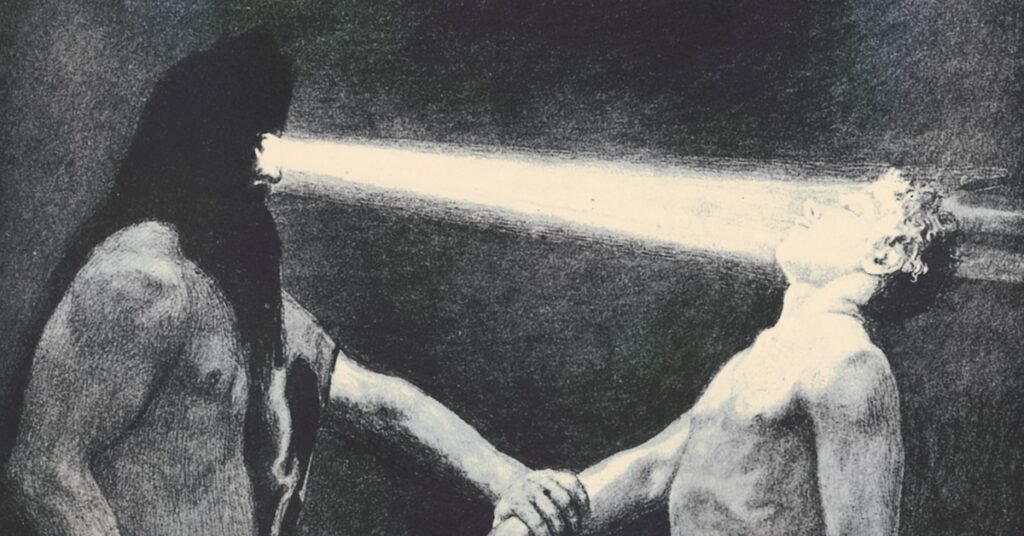
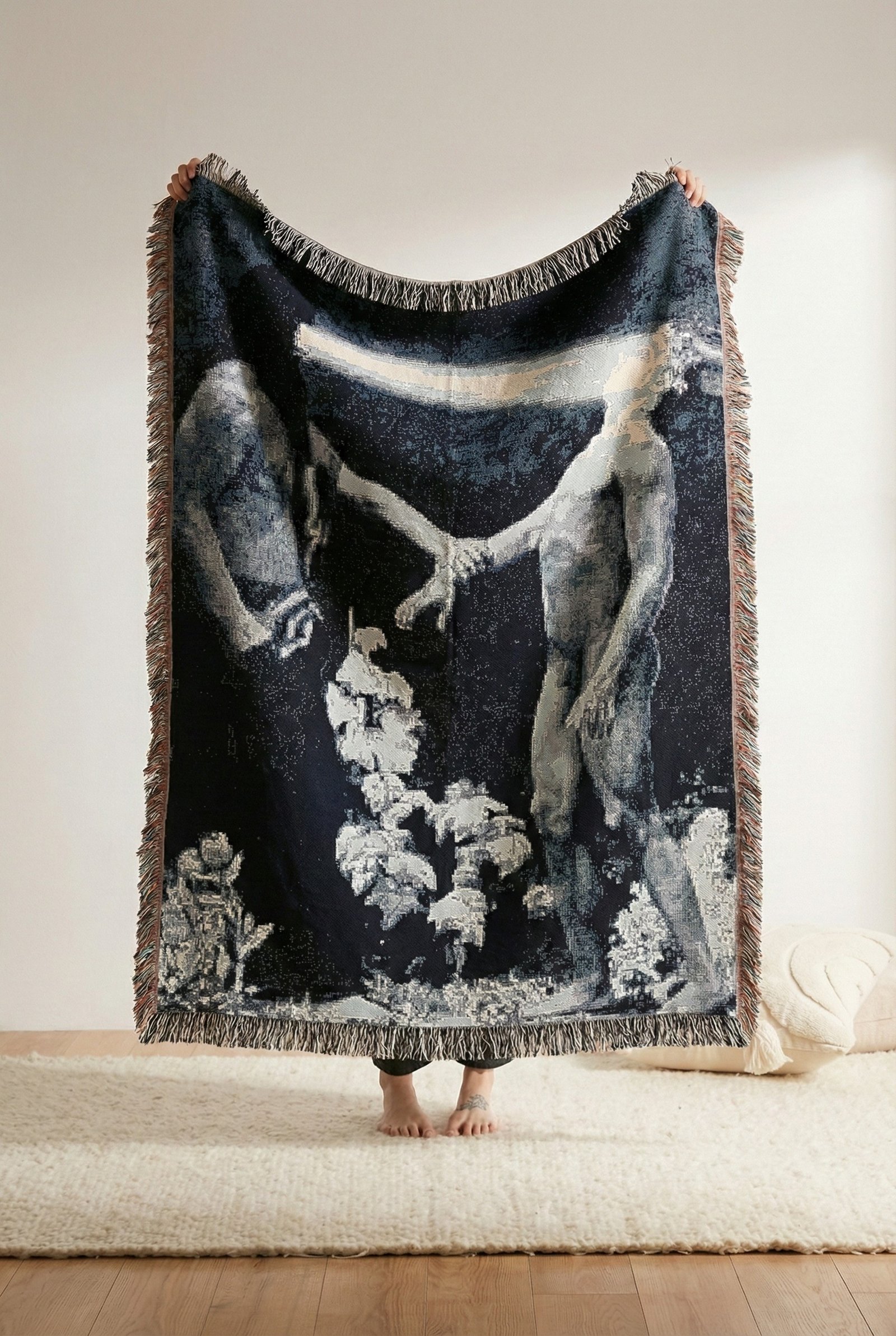
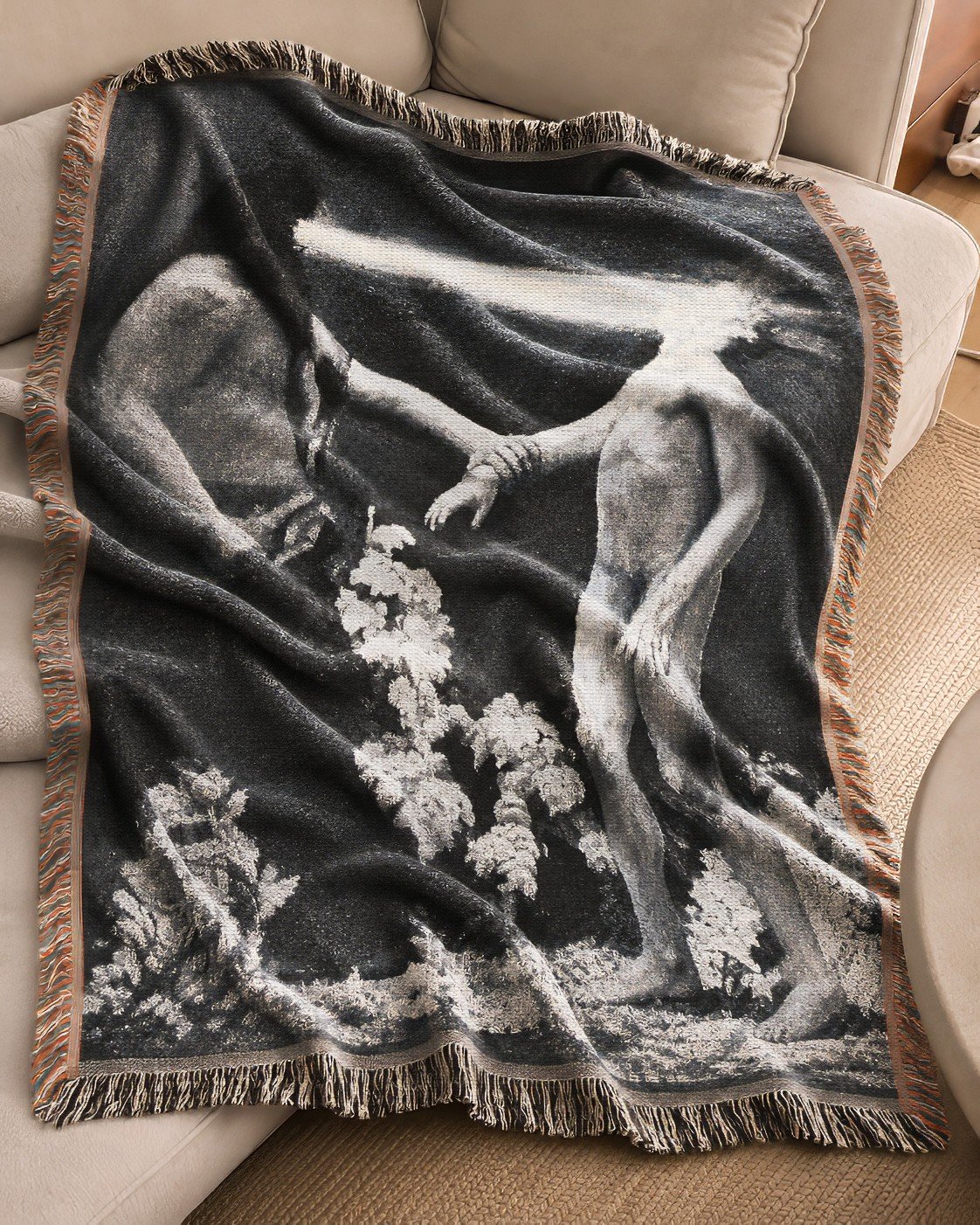
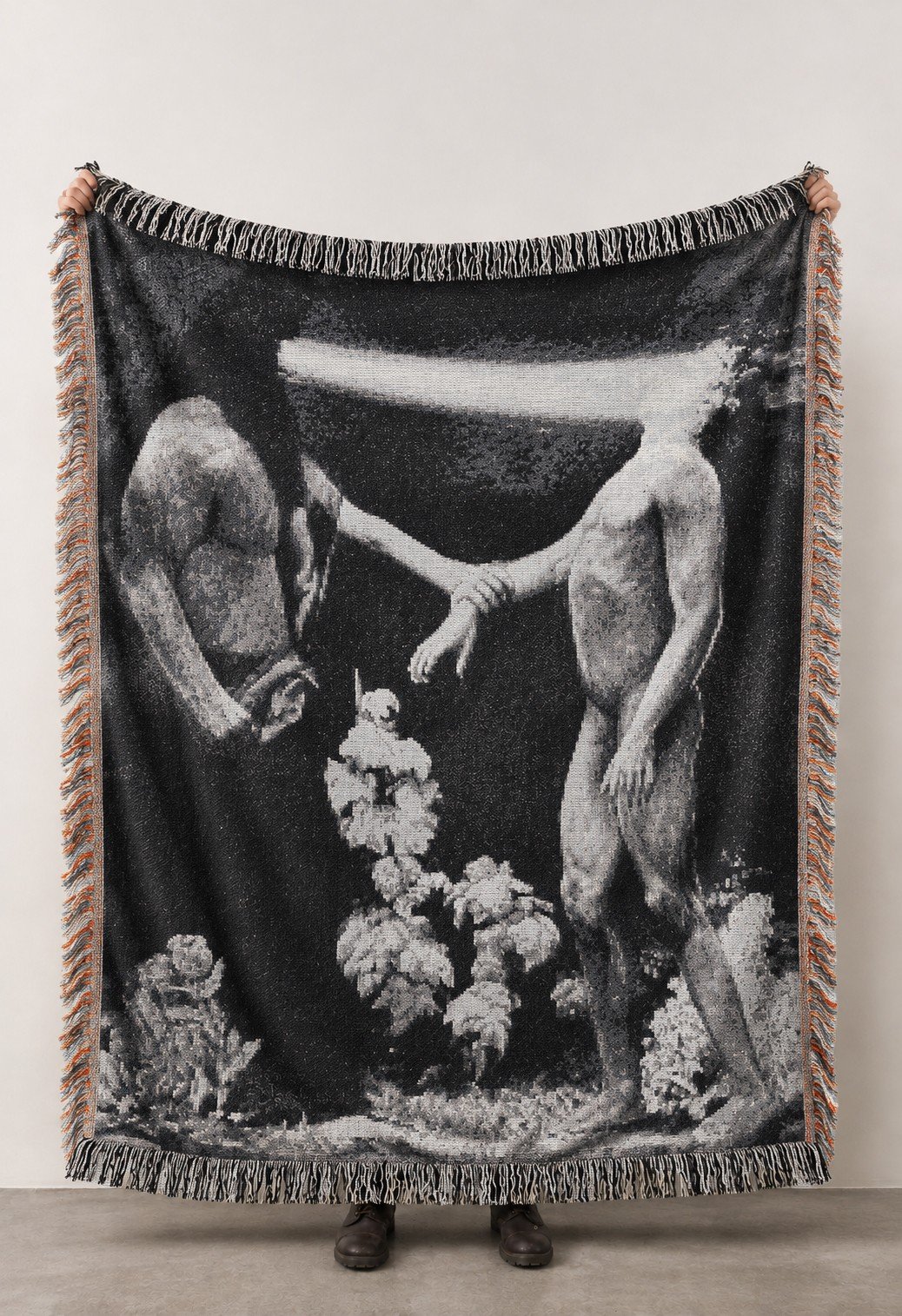
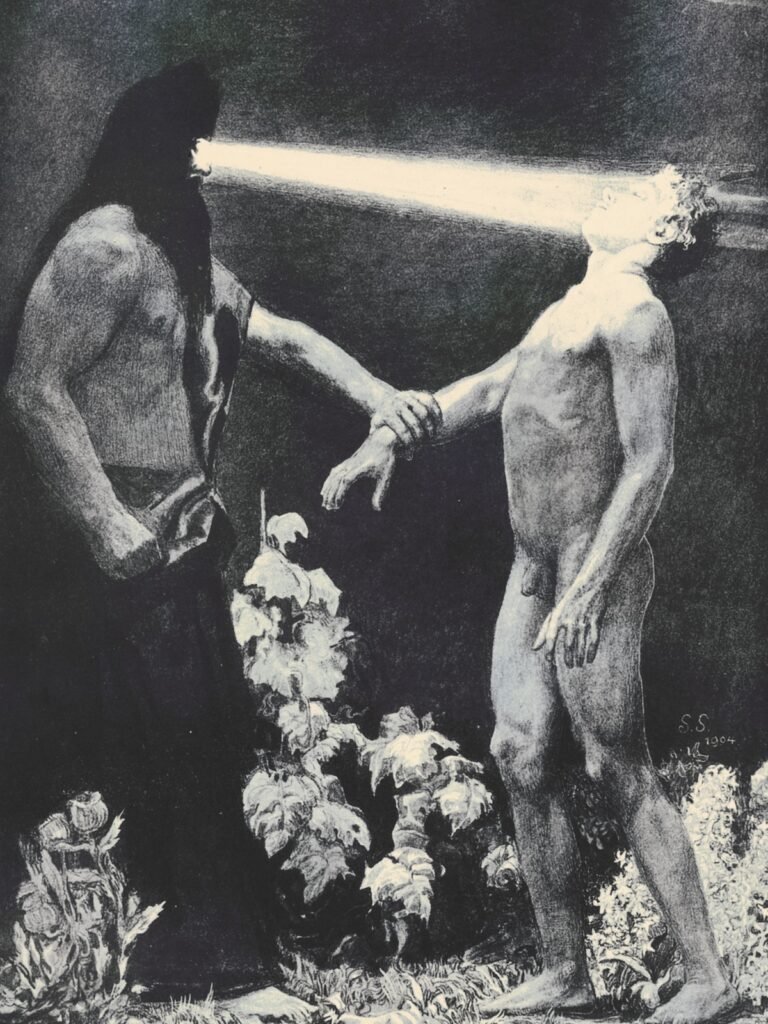
Hypnosis (Hypnose in German) is a black-and-white composition by the Symbolist artist Sascha Schneider. It bears his initials and the date at the lower right, S.S. 1904. Two figures are joined by a single beam of light. The beam begins where the older man’s eyes should be (the rest of his head is lost in black) and ends on the upturned face of a young man whom he holds by the wrist. There is no lamp or window in the scene, so within the picture the light seems to come from the hidden face itself.
The work dates from 1904, the year Schneider began working with the novelist Karl May and took up a professorship in Weimar. Its subject draws on the popular interest in hypnosis around 1900. The original is now considered lost, and its medium is uncertain. In 2019 the director Robert Eggers named it as the source for a shot in his film The Lighthouse.
Training and early career
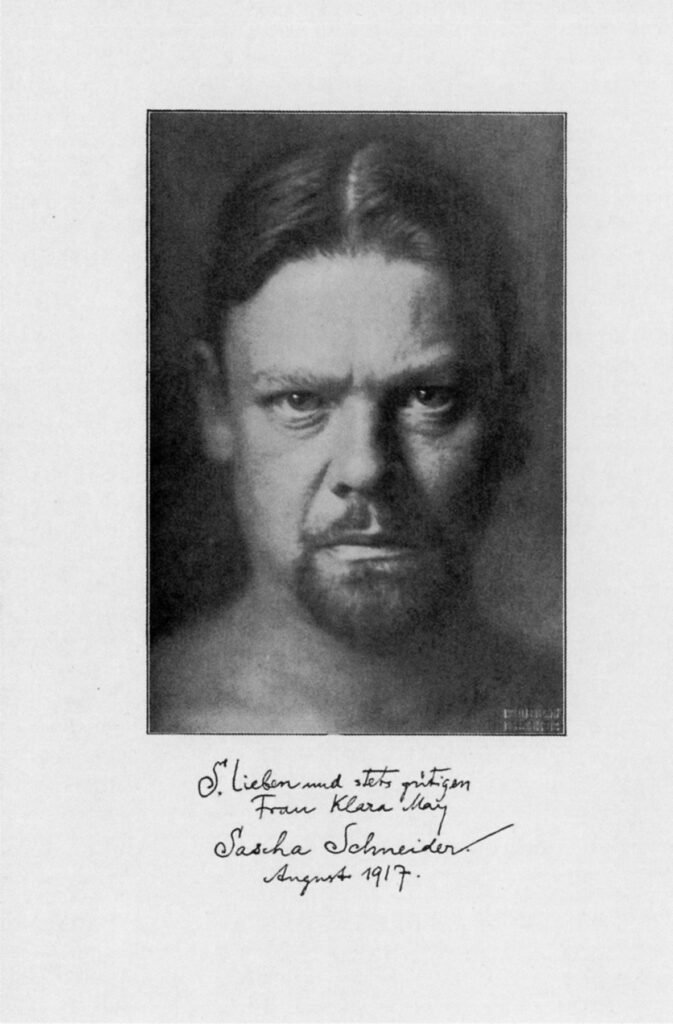
Schneider was born Rudolph Karl Alexander Schneider in Saint Petersburg in 1870. His family lived for a time in Zurich and moved to Dresden after his father’s death. In 1889 he began his studies at the Dresden Academy of Fine Arts, and he exhibited his work from 1894 onwards. Around 1902 he was commissioned to paint the foyer of the new opera house in Cologne.
Karl May and the professorship in Weimar
In 1903 Schneider met Karl May, the best-selling author of adventure novels such as Winnetou. May was drawn to Schneider’s symbolic style, and in 1904 the two agreed to work together. Schneider designed new covers for May’s books which, instead of illustrating scenes from the plots, presented the author’s central ideas in allegorical form. In the same year he was appointed professor at the Grand Ducal Saxon Art School in Weimar.
Symbolism and the interest in hypnosis
Schneider is counted among the Symbolists. Tate describes Symbolism as a late nineteenth-century movement that placed the expression of an idea above a realistic depiction of the natural world. In Tate’s account, its painters created dream worlds populated by mysterious figures drawn from literature, and among their recurring themes were love, fear, death and unrequited desire.
Hypnosis lent itself to this kind of art, and around 1900 it was also a subject of wide popular interest. Reinhold Gerling’s handbook Der praktische Hypnotiseur (The Practical Hypnotist), whose first preface is dated Christmas Day 1894, had reached its tenth edition by November 1904. In his study Cult of the Will: Nervousness and German Modernity (2008), the scholar Michael Cowan notes that Gerling also used Schneider’s image to illustrate his own lessons on hypnosis.
The composition
The two figures are set against a dark ground. On the left stands a powerfully built, bare-chested man; on the right, among pale leafy plants, stands a slim young man, nude and barefoot. The older man reaches across to grip the young man’s wrist, and the young man’s hand hangs limp from that grip.
The beam that runs between their faces is the brightest part of the picture, and it travels in one direction only, from the hidden face to the open one. The hold of one mind over another cannot be seen, yet the composition seems to make it as tangible as the arm that grips the wrist. Cowan reads the hypnotist’s muscular body in a similar way: for him it suggests hypnosis understood as a power analogous to physical force.
The hypnotist’s free hand
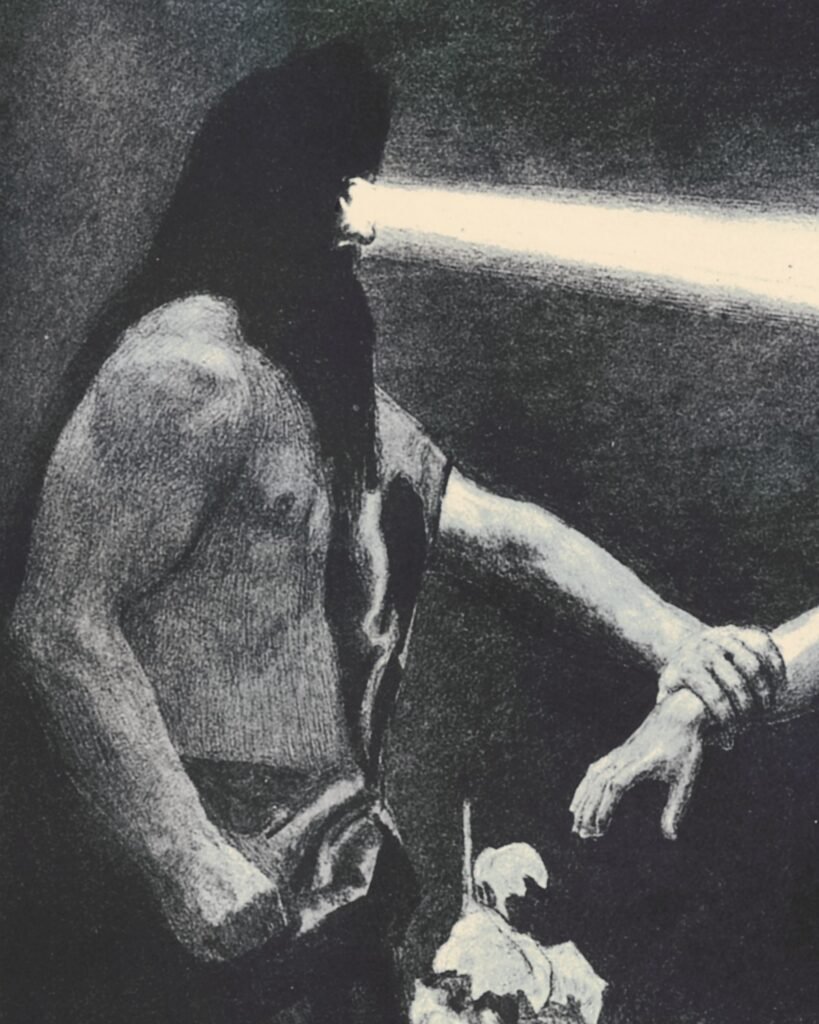
The beam leads the eye across the upper part of the composition, so a detail lower down is easy to overlook. The hypnotist’s other hand hangs at his hip, clenched into a fist, while the young man’s hands are open and loose. Set beside those hands and the even line of the beam, the fist suggests that the act of control demands an effort from the man who exerts it.
Medium and whereabouts
The Karl-May-Wiki describes the original as a drawing on card and records that Karl May and his wife Klara bought it in December 1906; its present whereabouts are unknown, and it is considered lost. Other sources describe the work as a painting or as an etching, and an exhibition in New York in 2013 included a lithograph of 1904 by Schneider titled Hypnotism. The public-domain reproduction on Wikimedia Commons was scanned from Hans-Gerd Röder’s 1995 book Sascha Schneider: Ein Maler für Karl May. Röder is the collector credited with preserving much of the artist’s work.
Later life
In Weimar, Schneider lived with the painter Hellmuth Jahn. Jahn began to blackmail him over his homosexuality, which was then a crime in Germany under Paragraph 175 of the penal code. Schneider left for Italy, where homosexuality was not criminalised, and later settled in Florence. His art also met with resistance. In 1912 a sculpture of bathing boys (Badende Knaben) that he had made for the Albertinum museum in Dresden was rejected on the grounds that it could incite “unnatural” indecency.
When the First World War began, Schneider returned to Germany. After the war he co-founded Kraft-Kunst, an institute for bodybuilding, and some of the young men who trained there posed for his art. The strong male body had been central to his work throughout his career. He died in 1927, aged 56, during a sea voyage near Swinemünde on the Baltic coast, and he is buried in Dresden.
The image in Robert Eggers’s The Lighthouse
The image reached the cinema more than a century after it was made. In Robert Eggers’s black-and-white film The Lighthouse (2019), Willem Dafoe plays the old lighthouse keeper Thomas Wake, and in one shot light beams from his eyes onto the younger keeper played by Robert Pattinson. When River Donaghey raised this shot in an interview for Vice, Eggers said plainly where it came from.
“…that particular shot is a rip-off of a Symbolist painter named Sascha Schneider.”
Robert Eggers, interviewed by River Donaghey, Vice, 15 October 2019
Eggers added that his own composition is different, but that Schneider’s Hypnose had stayed with him and seemed right for the story. At a press roundtable in Boston that month, he said that Schneider and a few other Symbolist painters had shaped the mythological images of the film. In both the picture and the shot, the light passes from the older figure to the face of the younger one.
Reputation
For a long time Schneider was remembered mainly for his covers for Karl May’s books, but this has begun to change. In 2013 the Leslie-Lohman Museum of Art in New York gave him his first exhibition in the United States and observed that, in his own day, his frank depiction of male beauty had made his art “paradoxically, so mainstream.” The Schwules Museum in Berlin followed in 2014 with an exhibition on his art and homoeroticism around 1900, and in 2023 the Museum für Kunst und Kulturgeschichte in Dortmund devoted an exhibition to his work and to the gender stereotypes of the same period. The original of Hypnosis has not been traced, so the image is known today through reproductions. In that form it went from Gerling’s printed lessons on hypnosis to the cinema of the twenty-first century.
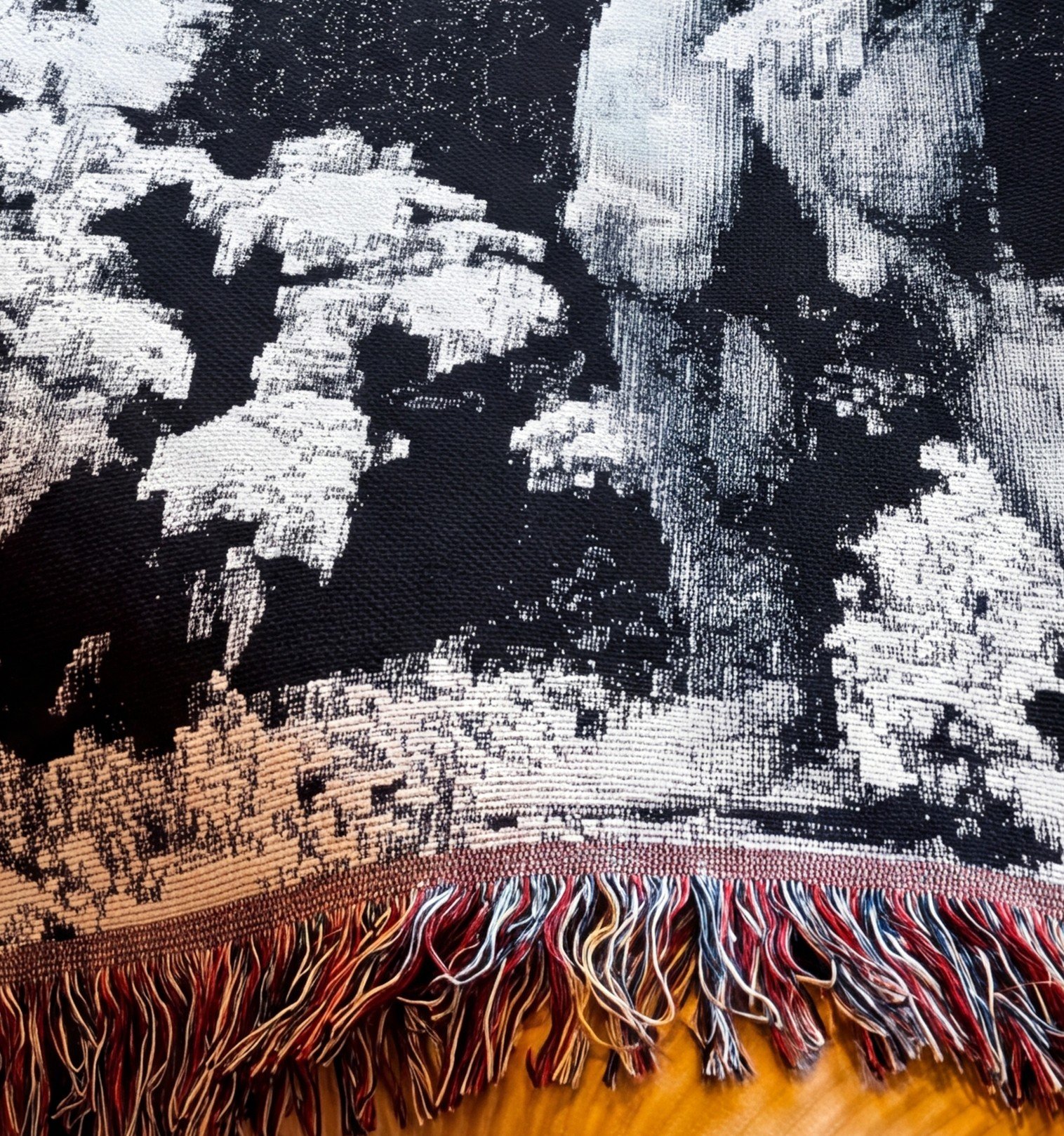
N° 010 Hypnosis is in The Noha Studio collection as a woven cotton piece.
Sources
- River Donaghey, “‘The Lighthouse’ Director Robert Eggers on Making the Most Bonkers Film of 2019,” Vice, 15 October 2019. vice.com
- Michael J. Cowan, Cult of the Will: Nervousness and German Modernity (University Park: Penn State University Press, 2008), as quoted in “Modernity and the Body: Sascha Schneider’s Bodybuilders,” ArtLark, 21 September 2022. artlark.org
- Reinhold Gerling, Der praktische Hypnotiseur, 12th edition (Wilhelm Möller, 1909), with the prefaces of 1894 and 1904. Projekt Gutenberg. projekt-gutenberg.org
- Christopher Panella, “Eggers talks mythos and making of ‘The Lighthouse’,” The Tufts Daily, 23 October 2019. tuftsdaily.com
- “Hypnose,” Karl-May-Wiki (citing Hatzig 1967, Röder 1995, Steinmetz and Vollmer 2009, Starck and Röder 2010). karl-may-wiki.de
- Tate, “Symbolism,” Art Terms. tate.org.uk
- Karl-May-Museum, Radebeul, “Fragile forces: Images on Karl May by Sascha Schneider and Rainer Griese,” exhibition, 2017–2018. karl-may-museum.de
- Leslie-Lohman Museum of Art, New York, “Nude in Public: Sascha Schneider, Homoeroticism and the Male Form circa 1900,” exhibition, 20 September – 8 December 2013. leslielohman.org
- Art Blart, “Exhibition: ‘Nude in Public: Sascha Schneider, Homoeroticism and the Male Form circa 1900’ at The Leslie-Lohman Museum of Gay and Lesbian Art, New York City,” 21 November 2013 (reprints the museum’s exhibition text and captions). artblart.com
- Stadt Dortmund, “Unheimlich schön: Ausstellung im MKK beleuchtet Geschlechterstereotype um 1900,” on the exhibition “Unheimlich schön. Geschlechterstereotype um 1900 bei Sascha Schneider,” Museum für Kunst und Kulturgeschichte, Dortmund, 8 September 2023 – 7 January 2024. dortmund.de
- “Sascha Schneider,” Wikipedia (English), citing Bernd-Ulrich Hergemöller, Mann für Mann, pp. 636–637. en.wikipedia.org
- “Sascha Schneider,” Wikipedia (German). de.wikipedia.org
- Erwin In het Panhuis, “Karl Mays ziemlich offen schwuler Künstlerfreund,” queer.de, 20 September 2020. queer.de
- Schwules Museum, Berlin, “‘I go my own way…’ Sascha Schneider – Art and Homoeroticism ca 1900,” exhibition, 28 March – 30 June 2014. schwulesmuseum.de
- KuLaDig, “Altes Opernhaus am Habsburgerring,” Cologne (built 1899–1902; names a ceiling painting by Schneider). kuladig.de
- “The Lighthouse (2019 film),” Wikipedia (English). en.wikipedia.org
- “File:Hypnose (Schneider).jpg,” Wikimedia Commons, scanned from Hans-Gerd Röder, Sascha Schneider: Ein Maler für Karl May (Bamberg: Karl-May-Verlag, 1995), p. 13. commons.wikimedia.org
- “Hypnosis,” Art History Project (lists the work as an etching and aquatint). arthistoryproject.com
- Project Runeberg, author page “Reinhold Gerling” (1863–1930). runeberg.org